The Abstinence Myth by Adi Jaffe PHD
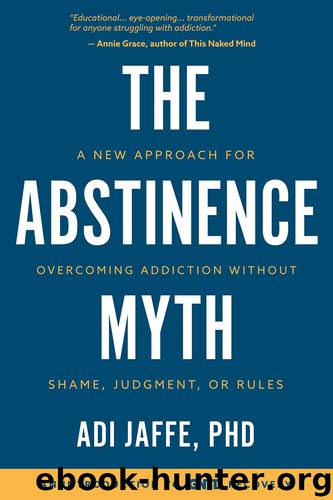
Author:Adi Jaffe PHD
Language: eng
Format: epub
Publisher: BookBaby
Published: 2018-07-03T12:19:26+00:00
The Myth of Sustained Abstinence as a Cure
Our focus on primary or single causes is compounded by our faith in a single solution. We have bought into the collective belief that abstinence is the only cure—abstinence now, forever, and completely. The “addiction recovery industrial complex” measures success in treatment by the percentage of clients abstinent a month, six-months, or a year after treatment, as if this singular yardstick is the be-all and end-all of success.
And success rates are dismal. Depending on what studies you believe and what population you pay attention to, current treatment success rates are between 10 and 35 percent—not exactly something to brag about66 and no better than the rate of improvement among those who don’t enter treatment.34 The sort of success rates you hear in marketing materials for the biggest treatment organizations are essentially pure fiction. Programs regularly tout 70 percent success rates and higher with no scientific rigor behind them and no transparency.
But it’s more than unsubstantiated claims. Research studies have repeatedly shown that a substantial proportion of participants in these studies actually lie about their abstinence. Numerous studies have shown that when comparing self-reported substance use to biological tests (such as breathalyzers or drug tests), people substantially underreport their use.67,68
One recent study found that, while 97 percent of participants actually consumed alcohol (as measured by an ankle sweat monitor), only 30 to 40 percent reported doing so.69 This shows us that, in reality, nearly all treatment participants drink during treatment, and the vast majority lie about it when asked—even when they know they’re being monitored. The social pressure of having to look good means that many people aren’t honest about their slips. We have created a system where people can’t be honest with their supposed helpers, and that sets up a terrible starting place for a therapeutic relationship.
Given the shame involved in telling someone that you’ve failed at reaching the goal of treatment—abstinence—it’s no wonder so many lie.
But this doesn’t surprise me in the least. Given the shame involved in telling someone that you’ve failed at reaching the goal of treatment—abstinence—it’s no wonder so many lie. Indeed, asking a former client the question ‘Are you sober?’ can result in what researchers call a social desirability bias, whereby those who respond feel obliged to give the therapist or treatment center (where they spent a lot of time and money) the answer they know is being sought: “Yes.”70
Obviously, we’re missing something big here, and most treatment centers would rather not admit it.
At least one of the things we’re missing is this: success, or recovery, is only partially related to abstinence. The Substance Abuse and Mental Health Services Administration (SAMHSA), the office dedicated to improving mental health and addiction in the US, defines recovery as:
A process of change through which individuals improve their health and wellness, live self-directed lives, and strive to reach their full potential.
SAMHSA’s definition of recovery doesn’t include abstinence anywhere within it. In fact, I tell those I work with that if all they achieved by working with me is abstinence, then I have failed them.
Download
This site does not store any files on its server. We only index and link to content provided by other sites. Please contact the content providers to delete copyright contents if any and email us, we'll remove relevant links or contents immediately.
Unwinding Anxiety by Judson Brewer(73396)
The Art of Coaching by Elena Aguilar(53612)
The Fast Metabolism Diet Cookbook by Haylie Pomroy(21243)
Rewire Your Anxious Brain by Catherine M. Pittman(18791)
Healthy Aging For Dummies by Brent Agin & Sharon Perkins RN(17117)
Talking to Strangers by Malcolm Gladwell(13521)
The Art of Thinking Clearly by Rolf Dobelli(10700)
Mindhunter: Inside the FBI's Elite Serial Crime Unit by John E. Douglas & Mark Olshaker(9503)
Crazy Rich Asians by Kevin Kwan(9409)
The Compound Effect by Darren Hardy(9143)
Tools of Titans by Timothy Ferriss(8579)
Periodization Training for Sports by Tudor Bompa(8411)
Becoming Supernatural by Dr. Joe Dispenza(8361)
Wonder by R. J. Palacio(8227)
Bodyweight Strength Training by Jay Cardiello(8026)
Crystal Healing for Women by Mariah K. Lyons(8000)
Change Your Questions, Change Your Life by Marilee Adams(7921)
Nudge - Improving Decisions about Health, Wealth, and Happiness by Thaler Sunstein(7844)
Therapeutic Modalities for Musculoskeletal Injuries, 4E by Craig R. Denegar & Ethan Saliba & Susan Saliba(7778)
